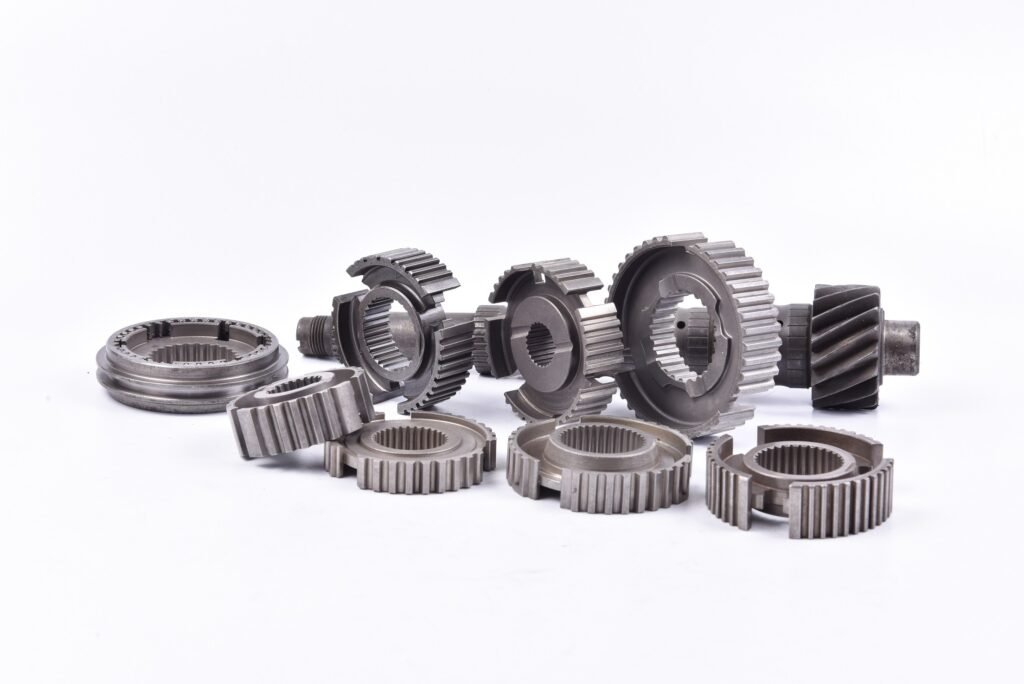
Benefits of Powder Metallurgy: What You Save, What You Get, and Why the Factory Matters
A factory-side look at why powder metallurgy is still the most economical route to high-volume precision metal parts—and why the difference between one PM shop and another directly impacts part cost, lead time, and batch consistency.
The Benefits, Ranked the Way Buyers and Engineers Care
Most “benefits of powder metallurgy” guides list generic advantages without context. On a real production floor, evaluation centers on three factors: unit cost reduction, dimensional stability, and production speed. Here is the breakdown ranked by practical impact:
1. Material Economy—The Benefit That Compounds
Machining a gear or structural bracket from bar stock cuts away 30% to 60% of purchased raw material. Powder metallurgy compacts near-net-shape parts directly, keeping material waste under 5%. This economy compounds twice: you pay for less raw material upfront, and you eliminate the machine hours, tool wear, and labor required to remove scrap metal.
2. Repeatable Tolerance—Die-Controlled Consistency
PM tolerances are governed by hard tooling geometry rather than manual machine offsets. Once compaction dies are ground to account for sintering shrinkage (typically 0.2%–0.5%), every pressed part inherits identical geometry. Sized bores hold ±0.025 mm tolerances reliably across high-volume production runs. Learn more about mold building on our tooling design page.
3. Near-Net-Shape Complexity at Press Speed
Complex features that require multiple CNC setups—such as internal teeth, splines, multilevel steps, blind bosses, and non-circular bores—form directly during the compaction stroke. Multi-level tooling executes these shapes in seconds per cycle, yielding far higher output rates than conventional machining centers.
4. In-House Tooling Unlocks Lead Times
Tooling design and manufacturing dictate product launch schedules. When dies are designed and built in-house—with DFM feedback within 48 hours, tooling completed in 20 working days, and first articles delivered at 25 days—your schedule remains under direct factory control rather than waiting in an outsourced machine shop queue.
5. Auditable Quality and Process Systems
IATF 16949 certification guarantees structured manufacturing controls: PPAP submissions, Cpk capability studies on critical features, first-article Zeiss CMM inspection reports, and MES batch-level traceability. For automotive and industrial buyers, this system ensures every production lot matches initial sample quality.
How PM Turns Powder into a Finished Part (30 Seconds)
Powder metallurgy relies on four tightly controlled process steps:
- Blending: Elemental or pre-alloyed metal powders are blended with organic lubricants and alloy additions to meet targeted MPIF material standards.
- Compacting: Automated PM presses fill the die cavity and apply high uniaxial pressure (400–800 MPa), forming a “green” compact with final structural geometry.
- Sintering: Parts pass through atmosphere-controlled furnaces below the alloy’s melting point (typically 1,120–1,180 °C for ferrous alloys), forming solid atomic bonds and predictable shrinkage (0.2–0.5%).
- Sizing / Secondary Finishing: A secondary pressing operation (sizing) tightens critical dimensions to ±0.025 mm. Optional secondary operations include CNC turning, oil impregnation, steam treating, or heat treatment.
For a detailed breakdown of furnace atmosphere and thermal profiles, explore our Sintering Process Explained and 5-Step PM Process Guide.
JH PM vs. a Typical PM Factory: The Five Differences
Because powder metallurgy is a standardized industrial process, supplier differentiation comes down to equipment capability, in-house process coverage, and quality verification systems.
1. Direct Factory Cost Structure
JH PM operates an integrated facility spanning tooling, pressing, sintering, sizing, and secondary machining under one roof. Eliminating outsourced sub-contractor markups provides a lower total landed cost per part while maintaining full quality ownership.
2. Equipment Scale and Dedicated Capacities
Our Shaoxing manufacturing site houses 19 automated PM presses ranging from 6 to 1,000 tonnes, 10 sintering furnaces (including 2 continuous mesh-belt lines with 3,000+ t/yr capacity), and 3 Zeiss CMMs. Tooling trial runs take place directly on production press lines, eliminating discrepancies between prototype presses and actual mass production setups.
3. Compressed Tooling and Sampling Lead Times
Integrated toolmaking speeds up project schedules: DFM analysis within 48 hours, die building in 20 working days, and CMM-inspected samples delivered at 25 days. Immediate engineering iteration keeps your time-to-market on schedule.
4. Direct Engineering Communication
Engineering requests, drawing revisions, and wall thickness optimization queries are handled directly by staff metallurgical and tooling engineers—preventing communication delays typical of third-party sales brokers.
5. Automotive-Grade IATF 16949 Systems
Dual certification to IATF 16949:2016 and ISO 9001:2015 guarantees full PPAP documentation, continuous statistical process control (Cpk ≥ 1.33), and raw material MES traceability for every batch leaving the plant.
| Operating Aspect | Typical PM Job Shop | JH PM Factory Direct |
|---|---|---|
| Tooling Production | Outsourced to third-party toolmakers | Built in-house; tried on actual production press line |
| Press Equipment | Few presses, limited tonnage range | 19 automatic presses (6-1,000 t, Shaoxing site) |
| Sintering Capacity | Batch furnaces only, shared capacity | 10 furnaces incl. 2 continuous mesh-belt lines (3,000+ t/yr) |
| Lead Time Schedule | Subject to external toolmaker queues | 20-day tooling, 25-day first articles, 48h DFM |
| Quality Certifications | Basic ISO 9001 or uncertified | IATF 16949:2016 + ISO 9001:2015, PPAP Level 3, MES |
| Inspection Equipment | Manual height gauges / optical comparators | 3 Zeiss CMMs, first-article report on every program |
| Communication | Sales agent with language relay | Direct technical support from PM process engineers |
| Process Coverage | Single process, secondaries outsourced | Pressing, sintering, sizing, and CNC secondaries in-house |
Three Viewpoints: Procurement, Designer, Engineer
The Procurement View: Cost per Function
Comparing unit quotes requires evaluating full technical specifications. A lower price might omit secondary sizing or steam treatment required for wear resistance. PM allows procurement teams to optimize cost-per-function by specifying as-sintered or sized features where applicable, reserving expensive grinding operations only for ultra-tight tolerance zones.
The Designer’s View: Design for PM Efficiency
PM advantages are maximized when components are designed specifically for axial compaction. Uniform wall thicknesses promote consistent powder fill, generous radius transitions extend tool life, and multi-level stepped features are easily formed using split-punch tooling. Review design guidelines on our PM Wall Thickness Rules page.
The Engineer’s View: Process Predictability
For process engineers, PM offers exceptionally predictable output. Die dimensions do not drift like cutting tool edges. Process stability is verified through automated furnace logging, density gradient checks, and regular Cpk capability reports, ensuring low scrap rates during automated downstream assembly.
Where PM Does Not Fit—And Process Alternatives
An honest engineering assessment identifies where powder metallurgy may not be the optimal process choice:
- Low Annual Production Volumes: Orders under 2,000 pieces per year rarely justify custom compaction tooling costs. CNC machining or 3D metal printing is more cost-effective for prototypes and small batches.
- Transverse Features & Undercuts: Cross-holes, internal threads, and side grooves cannot be ejected from axial compaction dies and require secondary CNC machining operations.
- Extreme Aspect Ratios: Extremely thin walls (< 0.8 mm) or very long, slender geometries create powder filling difficulties and density variation.
- Sub-10 Micron Tolerances: Tolerances tighter than ±0.010 mm exceed standard sizing capabilities and require secondary cylindrical or surface grinding.
Review full tolerance boundaries on our PM Tolerance Capability Matrix.
Engineering FAQ—Benefits of Powder Metallurgy
Evaluate Powder Metallurgy for Your Next Production Program
Submit your 2D/3D part drawings and annual volume requirements. Our engineering team provides a written DFM review within 48 hours—including recommended alloy selection, process routing, tolerance predictions, and total landed cost analysis.